Sumer is the earliest known civilization in the historical region of southern Mesopotamia (Southern Iraq) dating back to around 3000 BC. Details on arms and armour are somewhat vague, as historical finds have not yielded many weapons, shields or armour pieces. However, a lot can be interpreted from finds as The standard of Ur and the Steles of Vultures. Most importantly, in the context of this document, are the depictions of the very first type of armour. Which is also the reason why I decided to start from this point. Bronze was fairly scarce during this period meaning limited amounts of it were used for military purposes. Full helmets, suits of armour, swords and shields were barely, if at all, used. But helmets did exist, along with copper or bronze tipped spears. One of the most interesting things are the cloaks that seem to have been worn as a form of armour. We’ll be looking at some of these parts and explain what they might have looked like.
Sumerian Armour Depictions 2600-2400 BC
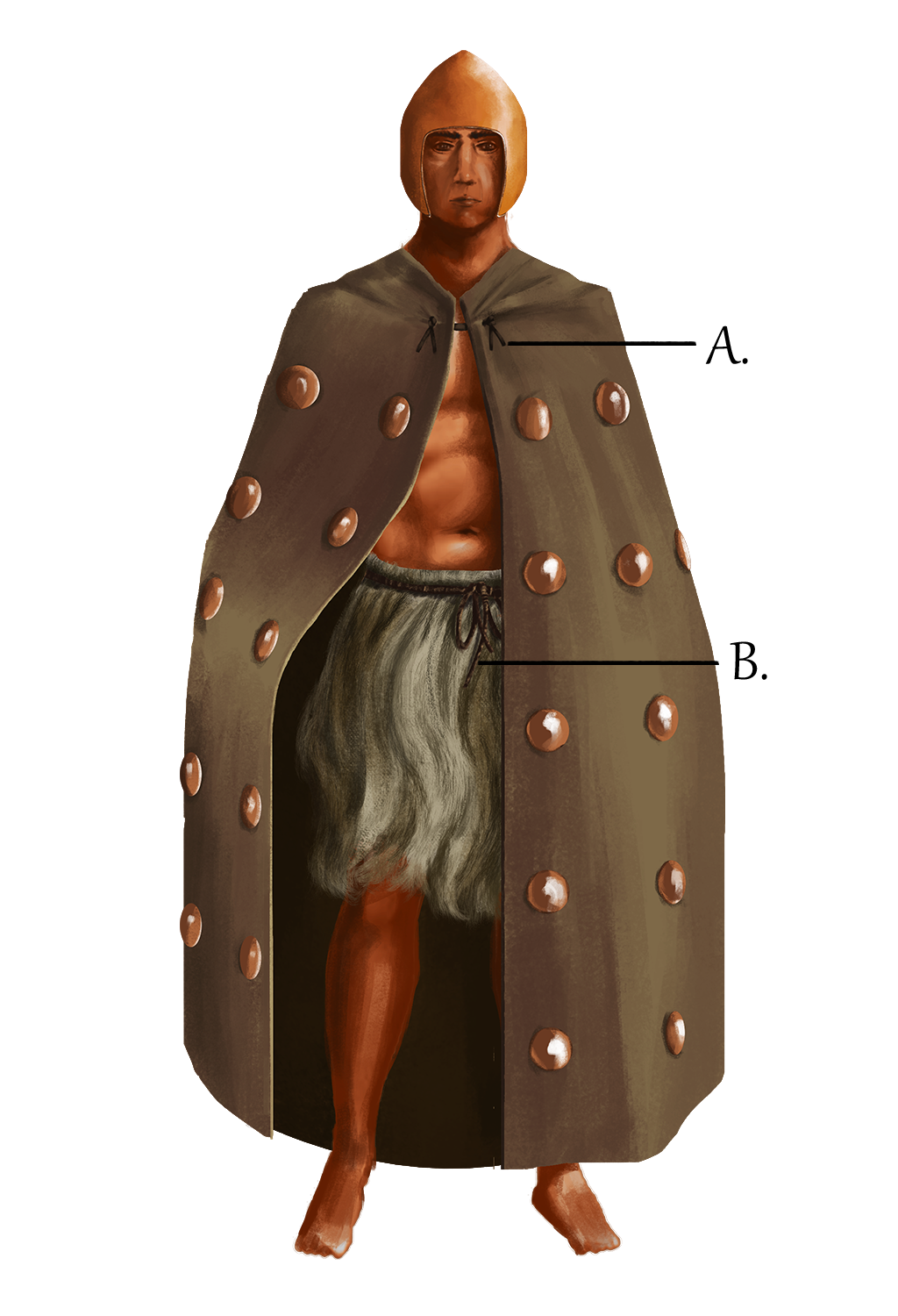
A. Likely a leather strap would keep the cloak together, although copper, tin or bronze cloak pins might have also been used.
B. Sheepskin skirts and cloaks were common.
According to an article on The Sumerian Military: Professionals of Weaponry and Warfare[1], this is the first example in history we have found of ‘armour’ being used, basic as it may be.
From the depictions on the Standard of Ur (figure 1.1) and the Stele of the Vultures, it seems a cloak was worn which had copper or bronze discs attached to it. The exact size and amount of these discs is difficult to determine, but most seem to have about 5 rows, or room for 5 rows of discs covering the cloaks.
Along with the cloak, the soldiers are depicted wearing helmets. We know these were likely to be copper helmets, as one ‘intact’ sample has been found in the Royal Tomb of Ur.

Sumerian Helmets 2525 BC
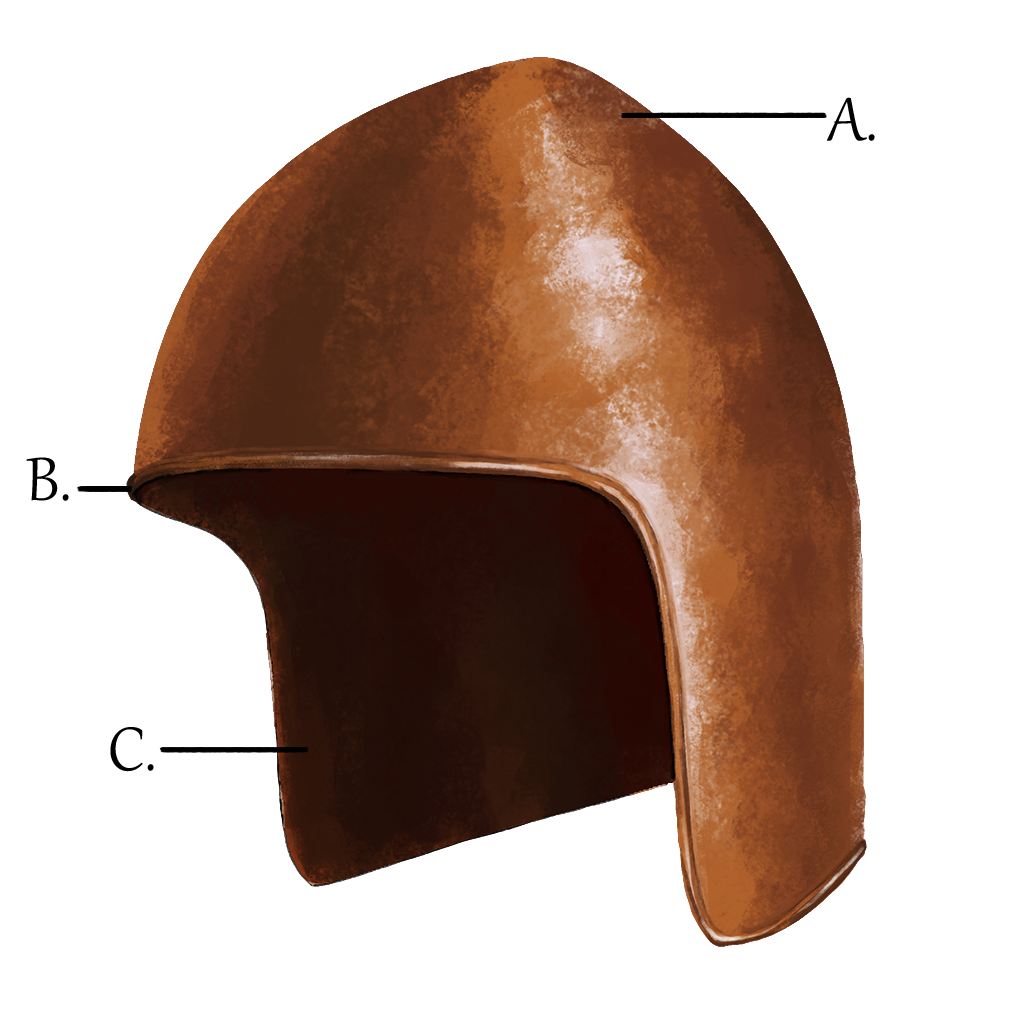
A. Slightly raised tip, creating a larger crumple zone.
B. The thick edge around the helmet is debatable.
C. Likely some form of padding would have been present of felt, linen or leather, but we simply aren’t sure.
Only one ‘intact’ sample of this type of helmet has been found in the Royal Tomb of Ur. This sample can now be found in The British Museum[2]. This sample was unfortunately flattened. As such it is difficult to get exact details. What we do know is that is was made of copper and had a slightly extended top. This was likely to create a larger buffer against axe and mace strikes. A quote from The Sumerian Military: Professionals of Weaponry and Warfare[1] says this: “The Sumerian helmet was a copper hat that was roughly two to three millimeters thick, fitting over a leather or wool cap, which provided another four millimeters of protection. In total, the helmet was a quarter of an inch thick. Some may speculate as to why the Sumerian soldier was fitted with a copper, rather than a bronze helmet. This may be due to the fact that the Sumerians had not developed the ability due to the difficulty in casting such a mold to fit the shape of a wearers head.” Unfortunately, because the sample is too damaged, or because they are simply not there, no holes could be found along the edges of the helmet. This begs the question of how padding was added to the inside. The probability of an inner padding is supported in the video: THE WORLD’S FIRST ARMIES: THE ARMIES OF SUMER AND AKKAD, 3500-2200 BC[3]. On the Stele of the Vultures the helmets are shown with a thick rim. Although whether this was a strip of leather or cloth that was sewn into the helm, as seen in later helmets, or an exaggerated thicker edge of the helm is hard to tell.
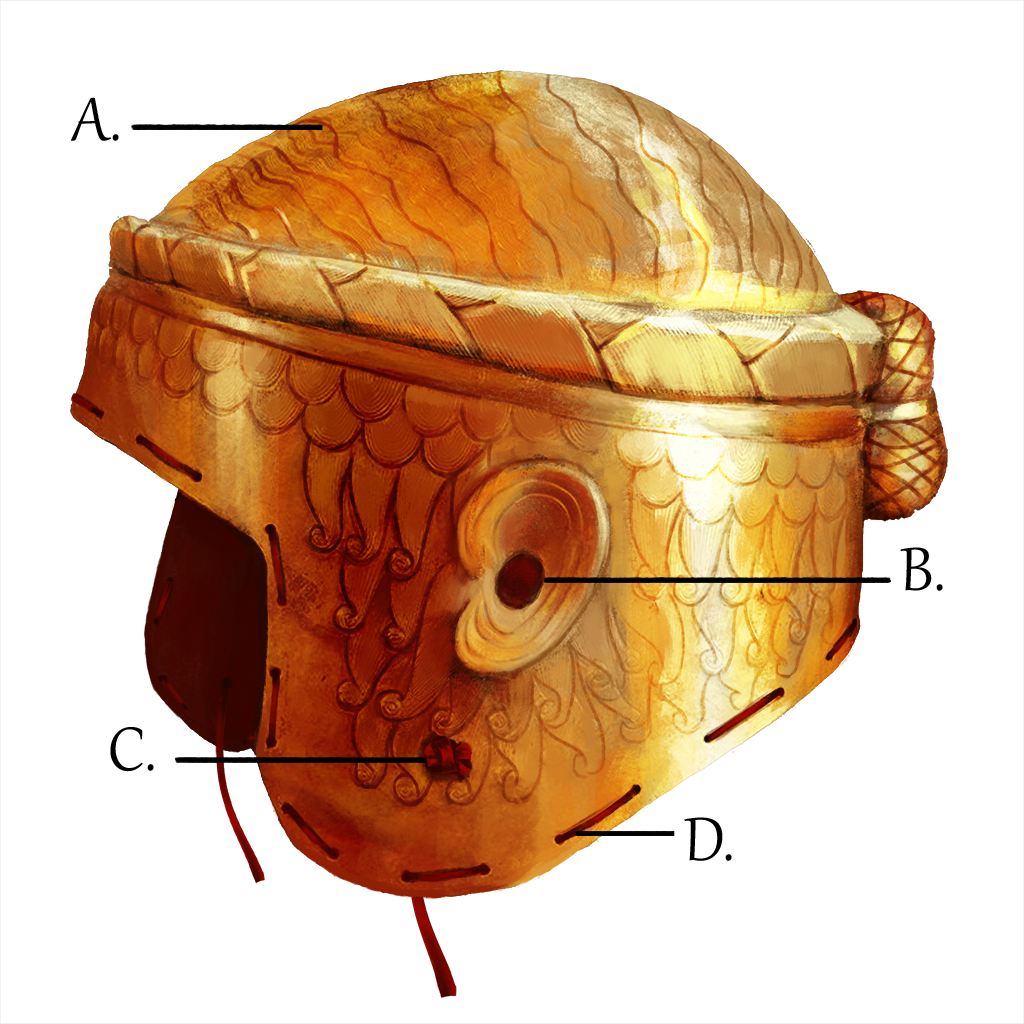
A. The decorations were made to resemble the wearer’s hair style.
B. An ear hole.
C. Likely these holes were used to keep a face mask in place. They might have doubled as holes for the chin straps.
D. The inner padding might have been sewn on in this way to show off more of the gold, but the padding might have also wrapped around the edge.
The golden helmet in figure 1.3 is a depiction of the helmet of King Meskalamdug. This was also found in the Tomb of Ur and was mostly intact. According to an article on SumerianShakespeare: The helmet of the King of Kish[4]; this type of helmet seemed to have been typical for the kings of this era. Multiple similar ones have been found in this shape dating from different times and from different materials, including gold and stone. Easily the most prominent detail is the braided hair at the back. This detail also makes it easier to locate the king on ancient carvings and depictions. The details on these types of helmets were made to resemble the wearer’s hair style.These helmets also often had a face mask to go along with them, shaped in the face of the king.
Sources
- 1. https://www.camrea.org/2016/10/05/the-sumerian-military-professionals-of-weaponry-and-warfare/ OCTOBER 5, 2016 BY REACAM7@GAMIL.COM The Sumerian Military: Professionals of Weaponry and Warfare
- 2. https://www.britishmuseum.org/research/collection_online/collection_object_details.aspx?objectId=371895&partId=1&searchText=crushed+skull&page=1.
- 3. https://www.bitchute.com/video/gfS-bnoRahA/
- 4. http://sumerianshakespeare.com/56701.html#top
 The Artists Guide to Arms & Armour