Mycenae was a prominent site in ancient greece and an important part of military history. The earliest dated full bronze armour set was found in this area, as described in BRONZE AGE GREEK WARRIOR 1600-1100 BC[5]. Specifically in Dendra, from which the finds date back to the early bronze age. Much is known about the military structure and tools from paintings on pottery and intact finds. The reason for so many weapons and armour pieces being found partly has to do with the large military force. As such, according to The end of Mycenaean civilization in Greece[6] an article in Ancient Warfare, an early form of conscription was in place.
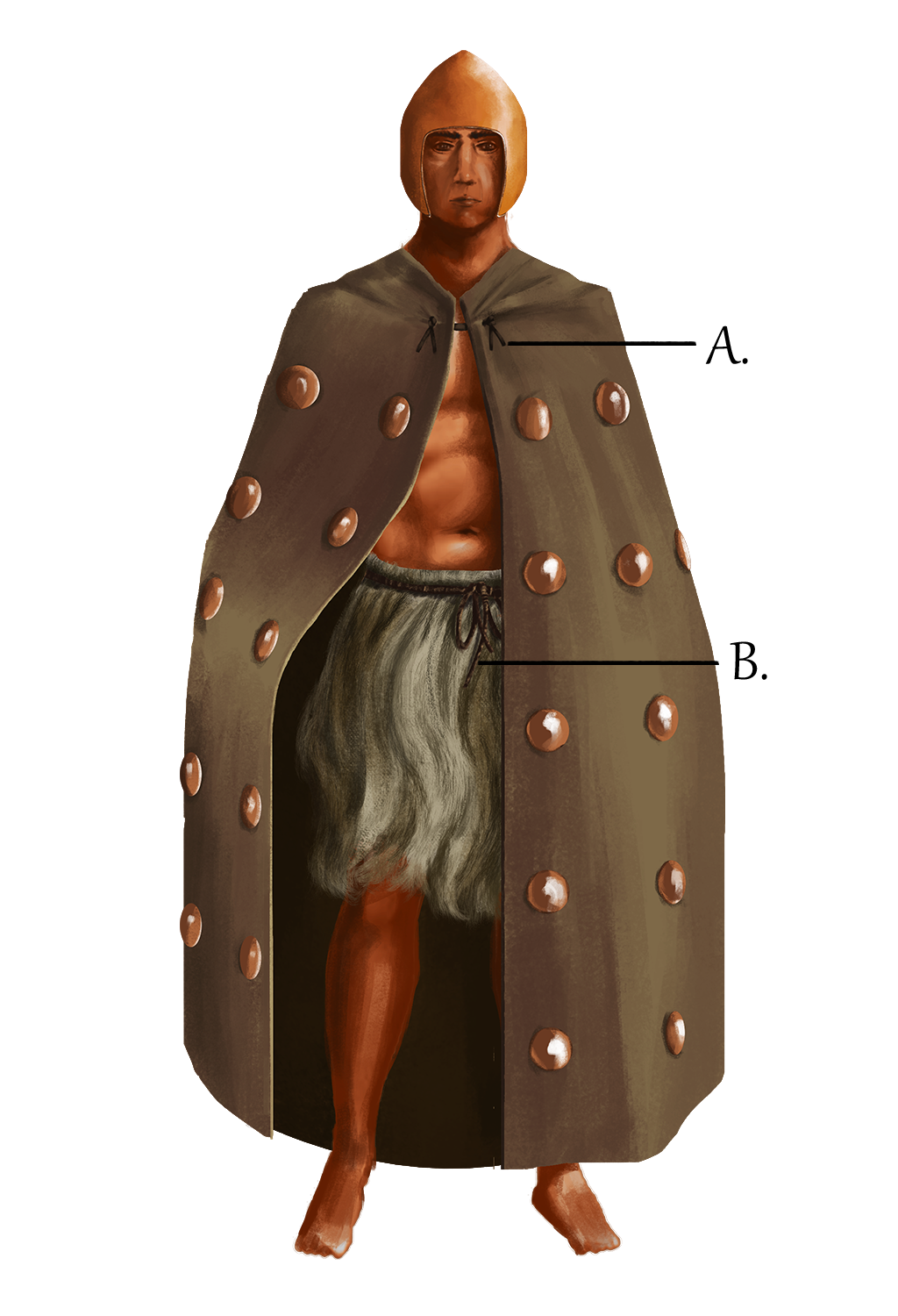
Achaean armour (15th-12th century BC)

A. Early examples likely wore a boar tusk helmet, or no helmet at all.
B. In a warrior burial at Liatovouni hill, dated 13th-12th Century BC bronze plates possibly from a reinforced kiton like this were found.
C. A helmet, pauldron and greaves would cover every part that wouldn’t be protected by a shield.
The earliest dated piece of bronze armor came from a Tomb near Dendra. Along with many other important finds, a lone bronze shoulder guard was found dating to 1550-1500 BC.
A possible meaning for this is that the rest of the armour was made from perishable materials. This is hypothesized in an article; The Greek Age of Bronze: Armour[7], where possible evidence for this is provided in the form of a seal-stone from Thisbe Boeotia dated around 1500 BC. The idea being that a large shield would cover the rest of the body with the shoulder guard covering the exposed arm.
In Figure 2 I took the liberty of depicting a variation on this armour. Here, a kiton is shown, an early form of pteruges, a bronze helmet and bronze greaves. A kiton or corselet is described a non-metallic cuirass. They were often constructed of many layers of linen sewn together, and sometimes reinforced with leather or bronze plates. Many possible examples of this are shown on pottery, dating back to 1600 BC, and they were even described in The Iliad. Examples can be found in this article The Greek Age of Bronze: Corselet and Kiton[8].
Pteruges are protective leather strips, sometimes reinforced with bronze plates. These became popular much later, namely after 1000 BC. However, a seal-stone from Haghia Triada, dated 1600 BC, possibly shows pteruges being worn.
Underneath the armour, simple linen or woolen clothes would have been worn as additional padding.
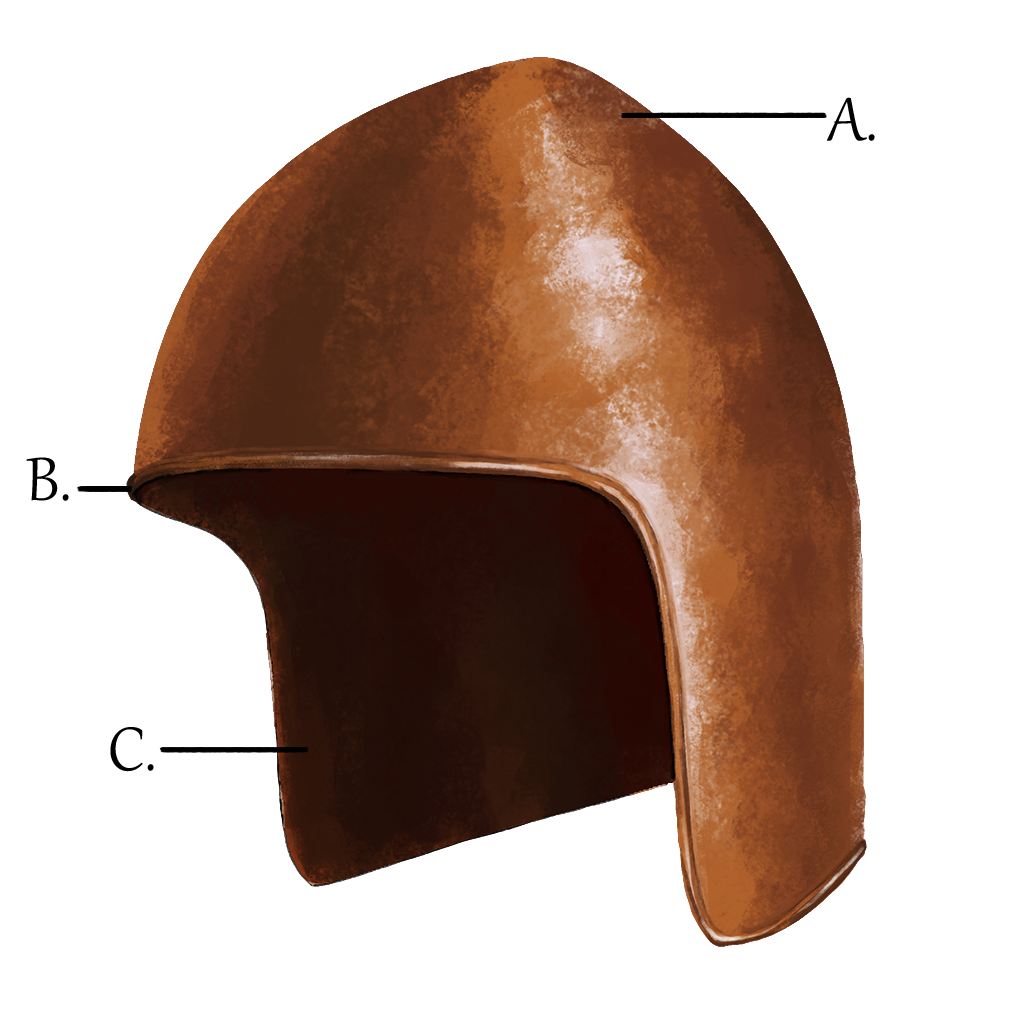
Boar tusk helmet (17th-10th century BC)

A. Leather strips might have covered the bones and the sewing to keep them in place.
B. Longer pieces of leather might have extended at the back as neck protection.
A boar tusk helmet is, obviously, a helmet made with boar tusks. Many variations exist. The first example of one having been found at the archeological site of Kolonna, dated to around 1800 BC. They likely grew in popularity somewhat later. The base of the helmet is created with a piece of leather, which is partly cut into strips. Or just a bunch of loose strips. The strips then converge at the top and center where they are tied together to create the basic shape of the helmet. Over the leather a felt or linen cap was sewn. Despite being made from mostly perishable materials, we know much about these. Mostly because many samples and depictions were found, and even in The Iliad, the construction is briefly described. The leather strips at the top could be covered with a wooden or bronze reinforcement, or kept open. An adornment Could be placed in the top like feathers or a crest of horse hair as hypothesised in Warfare in Ancient Greece[9]. To make one of these helmets, an estimated forty to fifty boars would be needed. Which, is a strange coincidence. As on Twitter, on August 4th, 2019, W. McNabb[10] argued he needed access to an AR-15 to defend his kids against thirty to fifty feral hogs. It is possible that in reality, this man required access to an AR-15 simply because he wanted to make a snazzy historical reconstruction of a boar tusk helmet. Later on, as bronze became more widely used, bronze was implemented into the construction of these helmets. This included bronze cheek guards. This further evolved into leather helmets reinforced with bronze, foregoing the bone entirely, and then into entirely bronze helmets. However, likely due to the relatively simple construction and low costs, the boar tusk helmets stuck around for a long time.
Dendra Panoply (1450-1400 BC)

A. Leather laces attached the shoulder guards to the cuirass here. This attachment allowed for one to move their arms up and down to some degree.
B. The right pauldron has a larger arm opening, likely to allow more movement.
C. These plates would fall in front of the armpit when raising an arm.
D. The leg plates could overlap each other upwards when moving the legs.
E. Bronze greaves tended to have a linen backing either directly sewn to the greaves, or strapped behind the greaves separately.
Figure 2.2 A depiction of the Dendra panoply as it might have looked like completely intact
The ‘Dendra panoply’ is called thus because it was found in one of the Dendra tombs along with many other pieces. This set is a special find, as it is the earliest dated full bronze armour set ever found. The entire set comprises of fifteen separate pieces, laced together with leather. Three Per shoulder guard, front and black plate, three leg plates for the front and back and the distinctive neck guard. Tallying up to around 15Kg. Along with this, arm guards, a helmet of various types and greaves might be have been worn.
The edges of the thin (1 to 2 mm) bronze plates were punctured with holes through which the padding was sewn. Underneath all of this it was likely that a standard set of clothing was worn, or possibly multiple layers. This type seems to have been common around those times, as many depictions have been found, and in The iliad, many bronze sets of armour were mentioned. However, yet again many variations existed. The article on armour from a site on The Greek Age of Bronze[7] notes that in Thebes, parts with a similar construction have been found. Most notably being the different leg guards and pauldrons, which tended to be smaller to allow for more movement. Considering that this armour was likely expensive to make, many sets were probably highly decorated. In The Iliad once again, armours are described to have been decorated with, silver, gold and possibly tin and ivory.
The ‘Dendra panoply’ is called thus because it was found in one of the Dendra tombs along with many other pieces. This set is a special find, as it is the earliest dated full bronze armour set ever found. The entire set comprises of fifteen separate pieces, laced together with leather. Three Per shoulder guard, front and black plate, three leg plates for the front and back and the distinctive neck guard. Tallying up to around 15Kg. Along with this, arm guards, a helmet of various types and greaves might be have been worn.
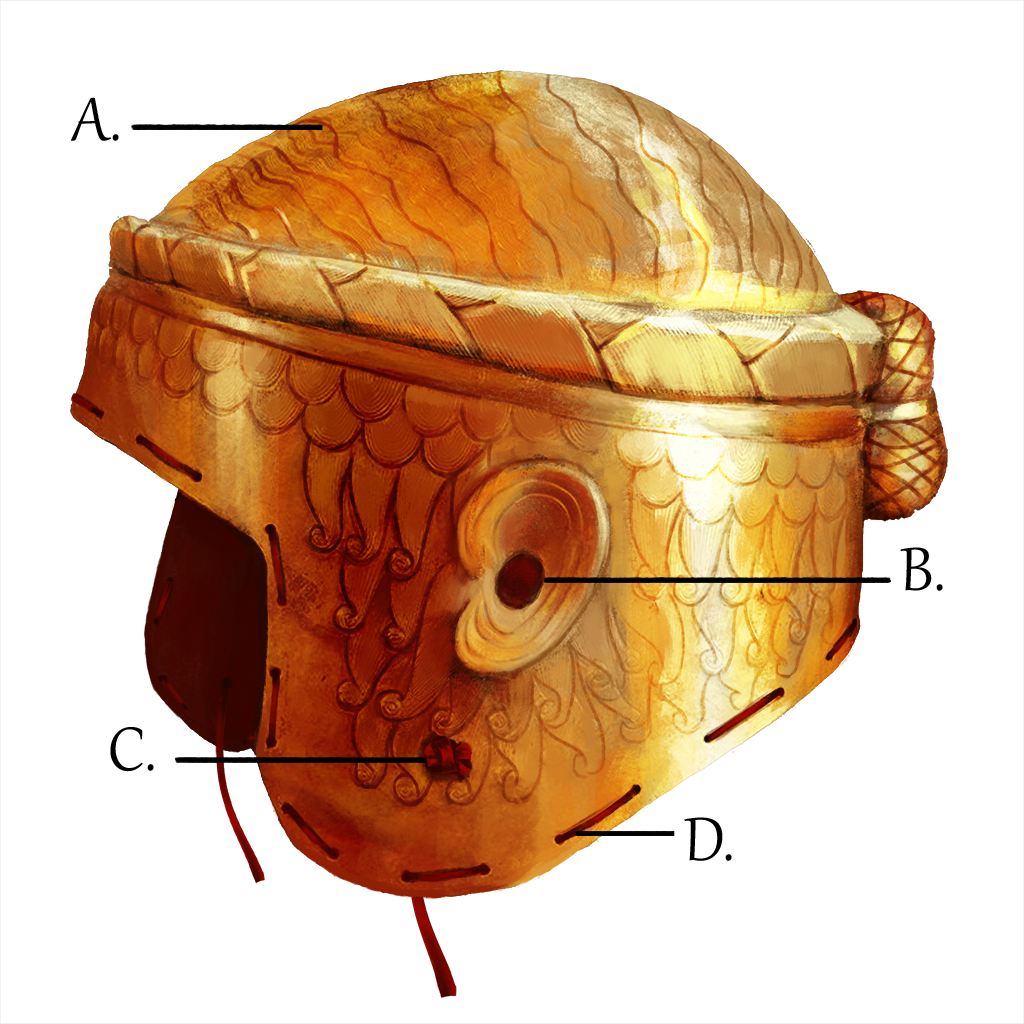
Bronze helmet from Knossos (1450)

A. A crest holder similar to a sample found in Knossos.
B. Stitching around the edges kept the inner padding in place.
C. A leather neck guard might have been present, along with a reinforcement in the form of a tin or bronze plate.
D. The cheek guards could have been either attached with hinges or riveted directly to the helmet.
Early examples of helmets which were fully constructed of bronze were found in ‘warrior graves’ near Knossos. These were dated to 1450 BC. The conical helmets had large cheek guards and many holes for the padding to be sewn in, which was likely made of linen, felt or leather. The bronze itself tended to not be thicker than just a few millimeters. From depictions on pottery it’s clear that many variations of bronze helmets existed. In Figure 2.3 There is also a neck guard present. It is not entirely clear how often this was done, however, in Knossos, some bronze plates were found near a helmet. Implying it might have been used as reinforcement for a neck guard made of perishable material. It seems crest holders were also common, just like on boar tusk helmets, and had many variations as well.
Sources
- 5. BRONZE AGE GREEK WARRIOR 1600-1100 BC RAFFAELE D’AMAT O & ANDRE A SALIMBETI
- 6. https://berlinarchaeology.files.wordpress.com/2015/01/brouwers-2010-palace_warriors-libre.pdf
- 7. http://www.salimbeti.com/micenei/armour1.htm
- 8. http://www.salimbeti.com/micenei/armour2.htm
- 9. Everson, Tim. Warfare in Ancient Greece
- 10. https://nypost.com/2019/08/06/what-does-30-50-feral-hogs-mean-anti-gun-control-tweet-goes-viral/

 The Artists Guide to Arms & Armour